Case Study / Hitchings Creative
An SEO tool that says what matters, and why.
Designing and building Maestro, a local-first desktop app that crawls a website, audits search, speed, security and AI visibility, and turns hundreds of data points into a clear, prioritized inspection report.
The Challenge
Reports full of problems. No idea where to start.
Most SEO tools answer one question: what's wrong with this website? For a local contractor, insurance agency or medical office, that answer is usually a long list of warnings with no sense of which ones cost them customers.
Running Hitchings Creative, I needed something different. Every prospect conversation starts with an honest look at their site, and every client relationship depends on showing that the work is moving the numbers that matter.
The key question
What matters most for this business, why does it matter, and what's the fix?
The Workflow
Inspect, report, then prove the improvement.
Maestro is built around the agency's real process. A prospect requests a free inspection, Maestro runs it, and the result is published as a branded report protected by an access code.
After the work starts, re-inspections and crawl comparisons show checks moving from failed to passed, so clients can see progress instead of taking it on faith.
Inspect
Crawl the site, run Lighthouse, check DNS, sample Google and AI answers.
Report
Eight checks, one verdict, and a recommended plan, published for the client.
Re-inspect
Compare crawls to prove what improved and catch what regressed.
The Architecture
Local-first. Fast enough for real sites.
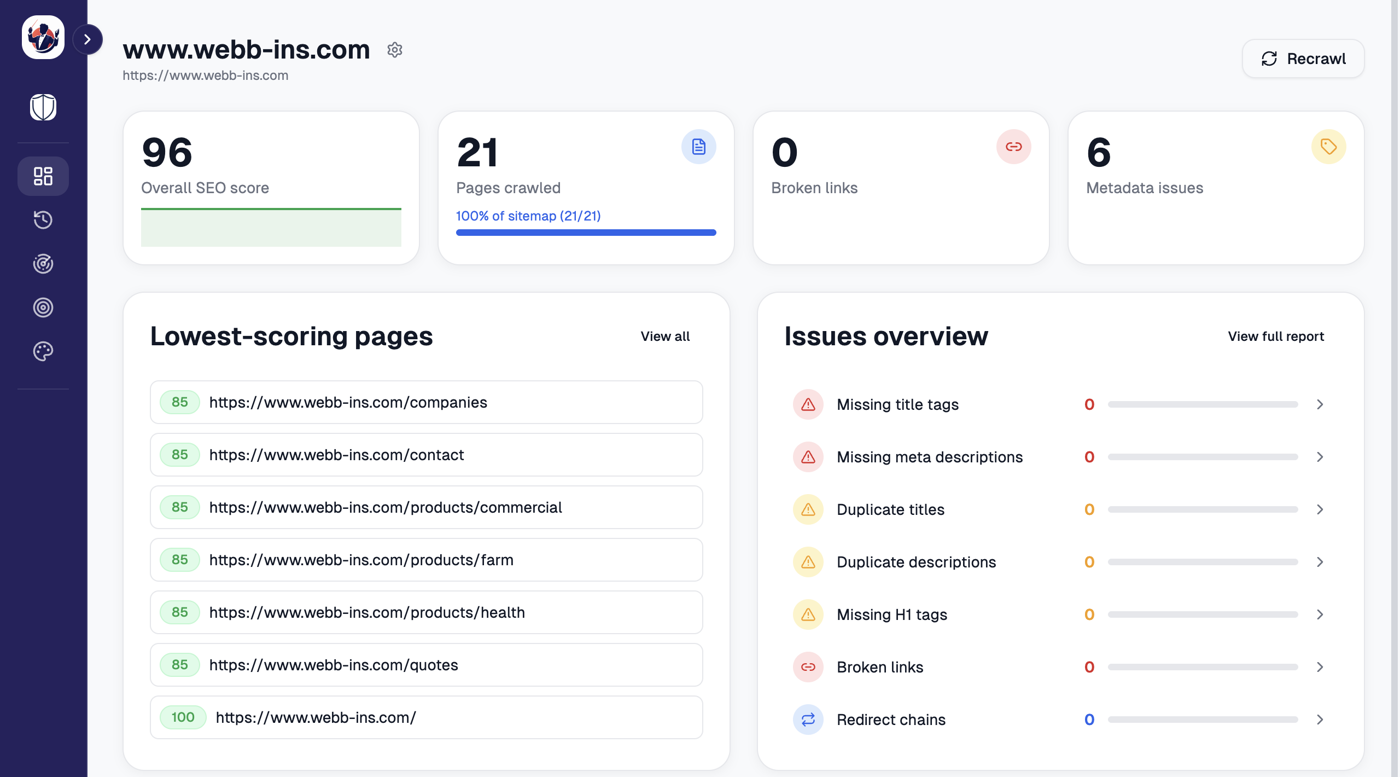
Maestro runs on the desktop, so it can crawl localhost, staging and VPN-only sites with no cloud infrastructure. Everything lands in a local SQLite database through Drizzle, and exports to CSV, JSON, sitemaps and shareable reports.
Crawls off the main thread
Early crawls ran in the Electron main process and could freeze the whole app. Each crawl now runs in its own worker thread with its own SQLite connection in WAL mode, with up to three sites crawling in parallel.
Swappable AI providers
One interface over a local Ollama model and the Claude API, so private sites can stay on the machine and client-facing work gets the stronger model.
Real browser rendering
Playwright renders JavaScript pages, follows redirect chains hop by hop and parses robots.txt and sitemaps, with a fast raw-HTTP mode when rendering isn't needed.
The Inspection
Eight checks. Four verdicts.
Every inspection grades the same eight checks in plain language: speed on phones, found on Google, shows up on the map, mentioned by AI, a page for every service, turns visitors into leads, secure and trustworthy, and email protected.
Each check is passed, needs work, or failed, and the combination produces a single verdict with clear rules behind it. A failed foundation check can't be hidden behind a good overall score.
Ready to compete
A solid site with customers to win.
Room to grow
The foundation holds. Steady fixes will add calls.
In good shape
The site is doing its job. Keep an eye on it.
Needs a rebuild
Patching won't pay off.
Visibility
Measuring search and AI, with healthy skepticism.
Maestro builds a market for each site from its services and towns, then samples Google results, the local map pack and AI assistants to see who actually shows up. Competitors and opportunities are scored from that evidence.
AI visibility is reported as evidence, not a hyped score. Opportunities grounded in Search Console data are labeled separately from AI estimates, so nobody plans a budget around a guess.
Search results
A self-hosted results scanner with a manual capture fallback.
Local map pack
Checks whether the business appears for nearby searches.
AI answers
Samples Claude, Perplexity and Google AI Overviews for brand mentions.
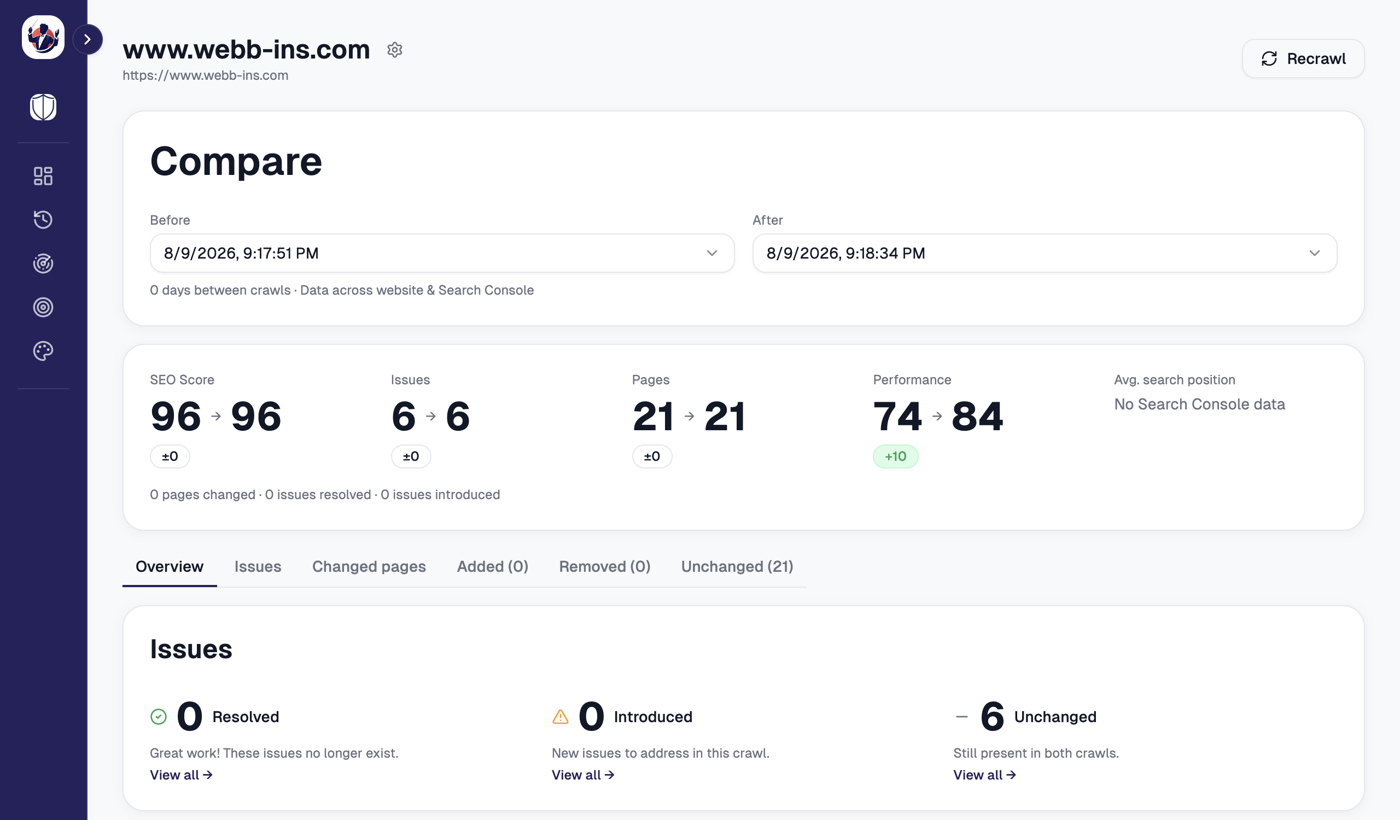
Crawl comparison
Before and after scores, issues and pages between any two crawls.
Reflection
Built for one agency. Shaped by real reports.
Maestro has grown through more than 130 commits, most of them driven by reviewing real inspection reports with real businesses. It inspected Webb Insurance's original site, guided the rebuild, and confirmed the result: from "Needs a rebuild" to "Ready to compete." It now hands reviewed research to the agency's CRM through a versioned sync contract.
Key takeaways
- A clear verdict beats a long list of warnings.
- Heavy work belongs off the UI thread, even on the desktop.
- Label AI estimates as estimates.
- The best roadmap came from reviewing real reports with real clients.