
Case Study / Optum
Modernizing the experience without stopping the business.
Co-architecting One UI, a micro-frontend platform that enabled the incremental modernization of three enterprise revenue cycle applications while supporting 12 active development teams.
The Challenge
Three applications. Twelve teams. One modernization strategy.
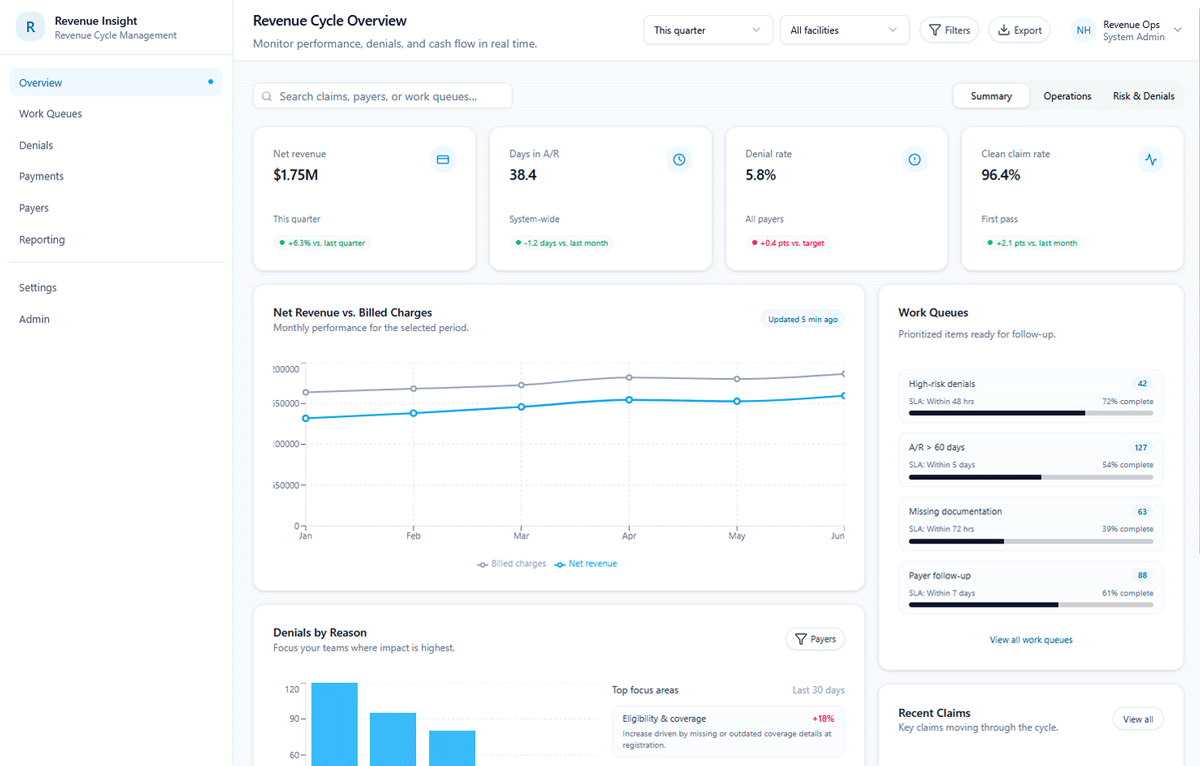
Optum's revenue cycle management ecosystem included three large, established applications, each with years of product development, business logic, and critical revenue cycle workflows.
Modernizing these systems presented a challenge: how do you replace the foundation of an application without disrupting ongoing product development or the people who depend on it?
With 12 active development teams, a complete rewrite would introduce significant delivery risk and delay the delivery of new capabilities. We needed an approach that allowed existing applications and new experiences to coexist, while gradually shifting functionality onto a modern, shared foundation.
The key question
How do you modernize three enterprise applications while teams are still building on top of them?
The Strategy
Incremental modernization using the Strangler Fig pattern.
We adopted the Strangler Fig pattern, progressively introducing new functionality and replacing legacy experiences within a modern application architecture.
This allowed modernization to happen in manageable increments, with existing applications continuing to operate throughout the transition.
Legacy
Existing applications continue to run while the platform is prepared.
Coexistence
Legacy and modern feature slices coexist and are migrated incrementally.
Modernized
A unified experience built on a modern, shared foundation.
My Role
Co-architecting the platform and guiding implementation.
As a co-architect and technical lead, I helped shape the technical direction of One UI and led development of the shared foundation used by multiple product teams.
My work spanned platform architecture, frontend integration, shared development patterns, design system adoption, and the coordination required to support independent teams working within a common ecosystem.
Platform architecture
Co-designed the micro-frontend foundation and integration model.
Legacy modernization
Defined migration strategy and supported incremental replacement of existing functionality.
Shared foundations
Established reusable libraries, platform primitives, and design system integration.
Cross-team enablement
Helped 12 development teams work independently within a common platform.
The Technical Architecture
Independently built. Seamlessly connected.
One UI is a micro-frontend platform built with Webpack Module Federation inside an Nx monorepo. The architecture provides a unified application shell, shared platform primitives, and clear boundaries between independently owned feature applications.
Webpack Module Federation
Enabled separately owned frontend features to be composed into a unified experience, with independent development and deployment.
Nx monorepo
Provided a common development ecosystem for organizing shared libraries and maintaining platform conventions.
Design system and platform primitives
Integrated shared UI components and utilities to create a consistent experience across all applications.
Outcomes
A foundation for modernization at enterprise scale.
One UI provided a common architectural foundation for bringing three independently developed revenue cycle applications into a more cohesive experience. The platform supported parallel development across 12 teams while reducing the need for tightly coupled feature delivery.
Incremental migration
Modernization without a single high-risk cutover.
Parallel delivery
Multiple teams developing feature slices concurrently.
Unified experience
Consistent interface across previously separate products.
Reusable foundation
Shared platform conventions and frontend libraries.
Reflection
Lessons learned and what's next.
The project reinforced the value of incremental modernization, clear platform boundaries, and strong collaboration between architecture and product teams.
Key takeaways
- Incremental progress creates momentum and reduces risk.
- Platform success requires both technical and organizational alignment.
- Clear boundaries and contracts enable team autonomy.
- Observability and monitoring are essential at scale.